.jpg&zc=1&w=600&h=450)


Shapes of Stories
SHAPES OF STORIES
Participating Artists
Diane Alexandre, Maria Alexiou, Nikolas Athanasopoulos (Niklas), Maria Economides, Anna Karountzou, Panagiotis Lezes, Janet Lines, Alexandra Manousaki, Natalia Manta, Maru Meleniou, Angeliki Stamatakou, Philippos Theodorides, Irini Theodosi (irzzy), Yiorgos Trichas, Melina Xenaki
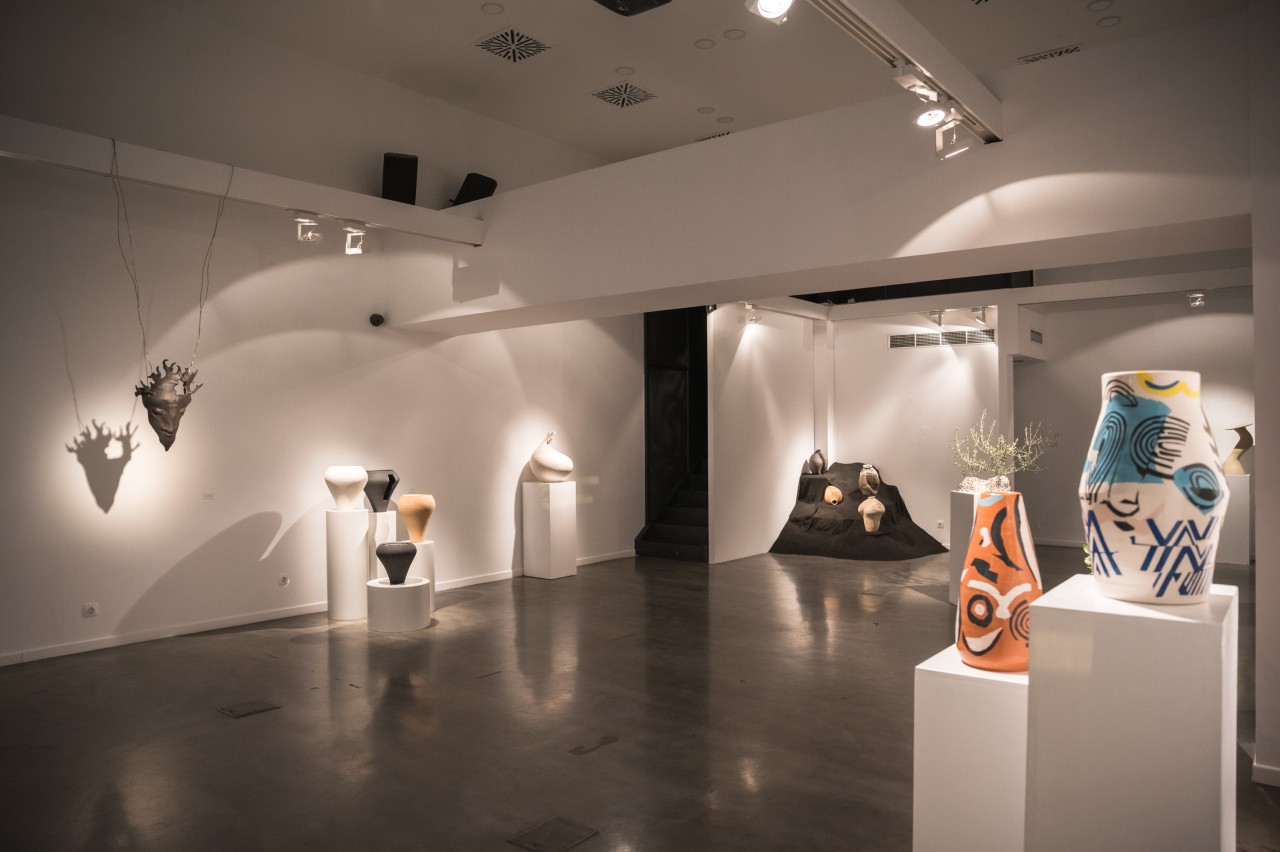
On its ten year anniversary, The Blender Gallery is pleased to present a group show exhibition of contemporary ceramics artists, titled Shapes Of Stories.
On account of the enormous range of creative experiment, free expression and development that ceramic art offers and the fact that there is a continuously growing trend and emphasis on what is handmade, on quality and not so much on mass and homogenized production, 15 contemporary ceramic artists are invited to create artworks that redefine the concept of ceramics and the use of materials, emphasizing how indelible it remains as an art form over the years, shaping our cultural heritage under the prism of a contemporary viewpoint.
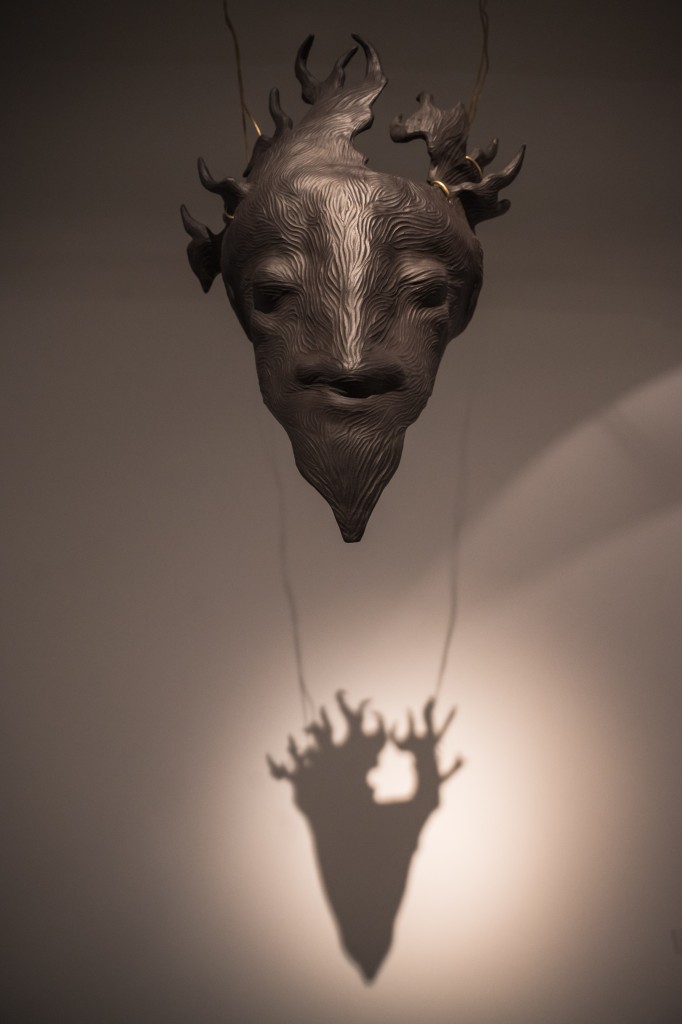
Diane Alexandre’s piece “με κλειστά μάτια” is an ensemble constituted of a black stoneware hand-build and carved mask with bronze details and white porcelain depicting the Minotaur who represents the entrapment of the self, the impossibility to move past a destructive pattern, the oblivious blindness of the heart. The artist states that “With closed eyes, we refuse to see ourselves, but also we totally trust someone else. This piece is a song to love, the one that hurts and the one that saves”. The work is hanging from the ceiling so the viewer can “wear” it and see for a while through the eyes of the artist.
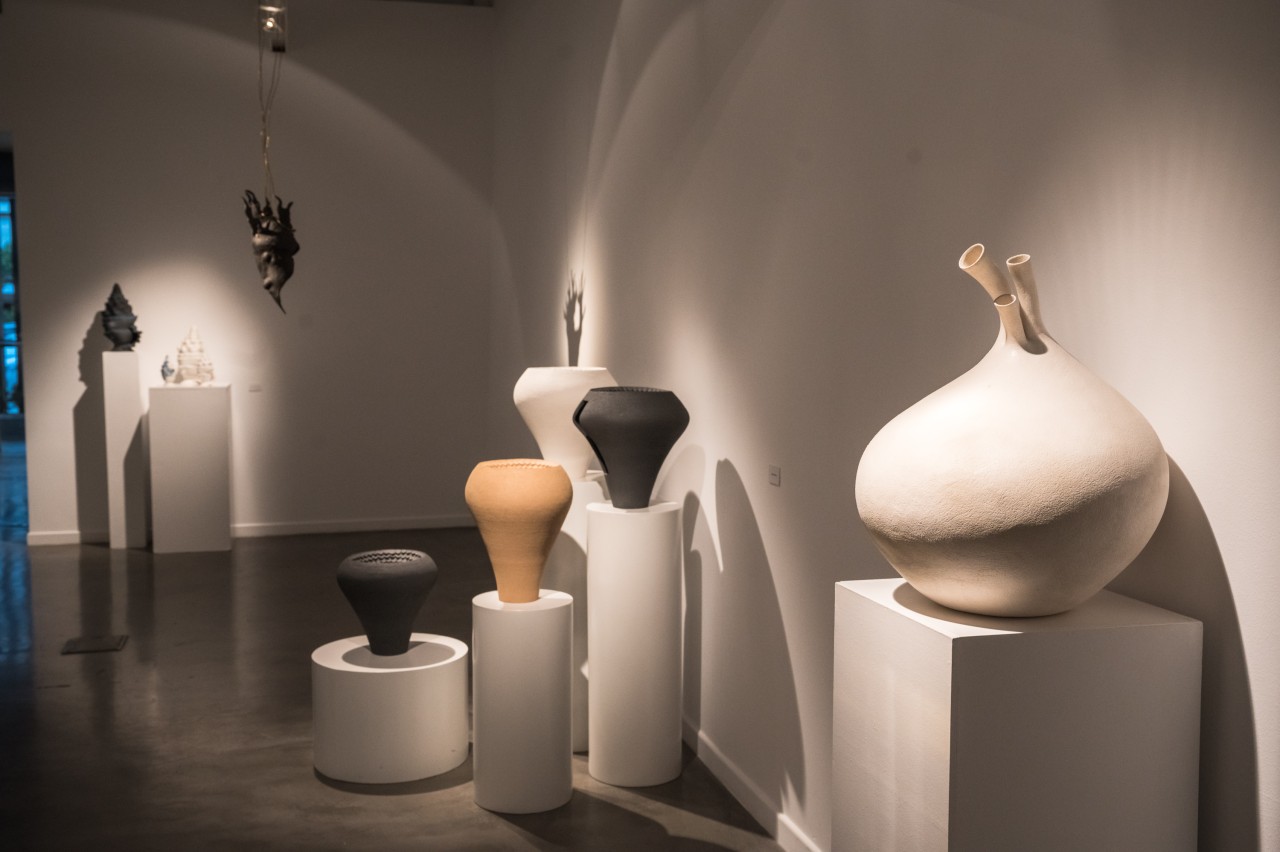
Angeliki Stamatakou is inspired by the infinite beauty of nature and the reality of the society in which she exists. The Greek artist observes, investigates and understands how she, and the world, are evolving by expressing her personal aesthetic, angle and emotions through her sculptures. She combines her personal aesthetics with technical methods in order to redefine the vase in a modern, sculptural context.
The same goes for Maria Alexiou too as nature has always been a source of inspiration to her. For the exhibition, Alexiou’s works have been created after her study of the shape of mushrooms. Specifically, the artist says “The infinite forms and patterns that present themselves as well as their stories. Fungi shapes are in themselves a frozen frame of a dance that unfolds. Mushrooms are to be searched for, hidden and fragile. Underneath what we discover is a whole new world. An endless structure that is integral to the development of entire ecosystems'' Her work is merely an ode to mushrooms.
Yiorgos Trichas' work has references to his place of origin, Syros island that offers him a unique sense of freedom and a deep appreciation of art as an essential part of the quotidien. It reminds him of who he is and who he wants to be. It is there that he draws his inspiration from; the cycladic light streaming in through the shutters, the smell of bare earth, the pastel hues, the neoclassical architecture.
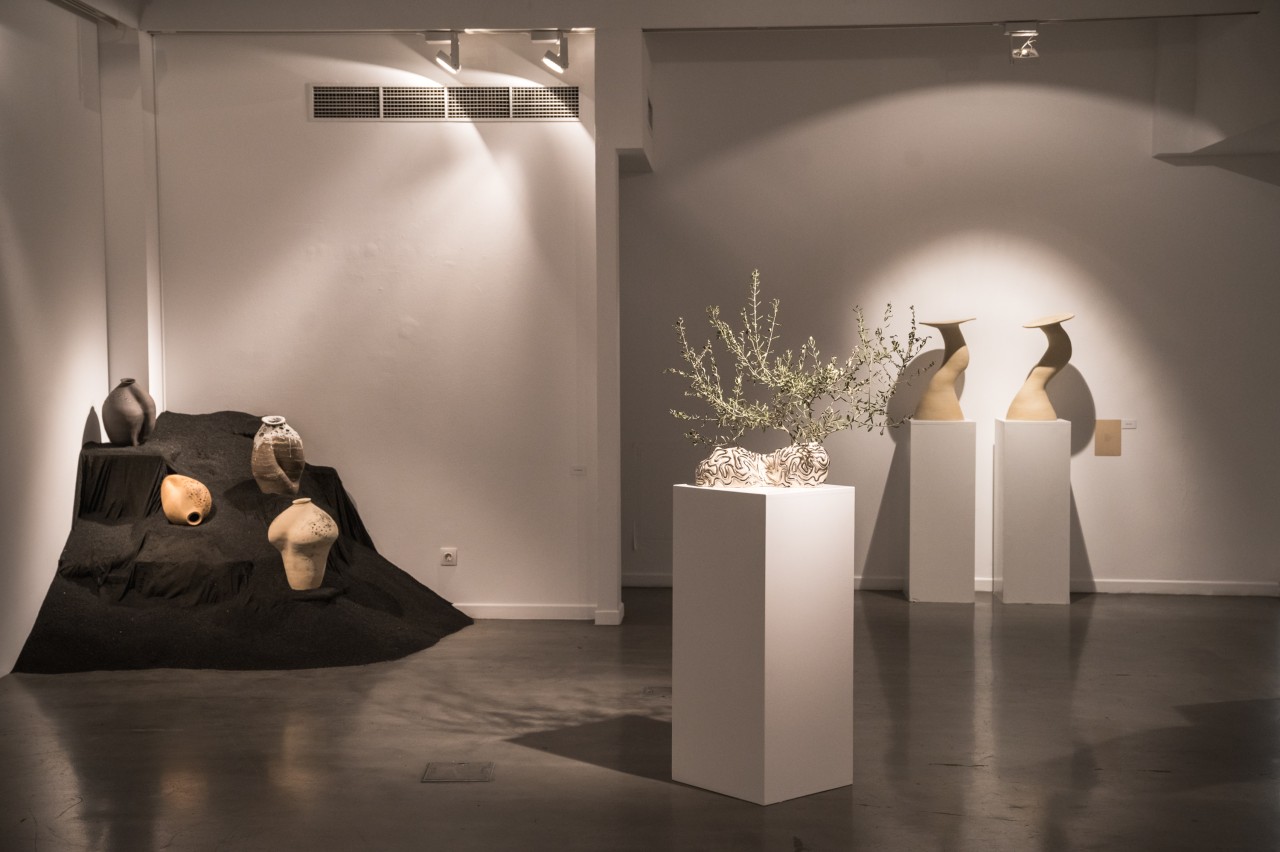
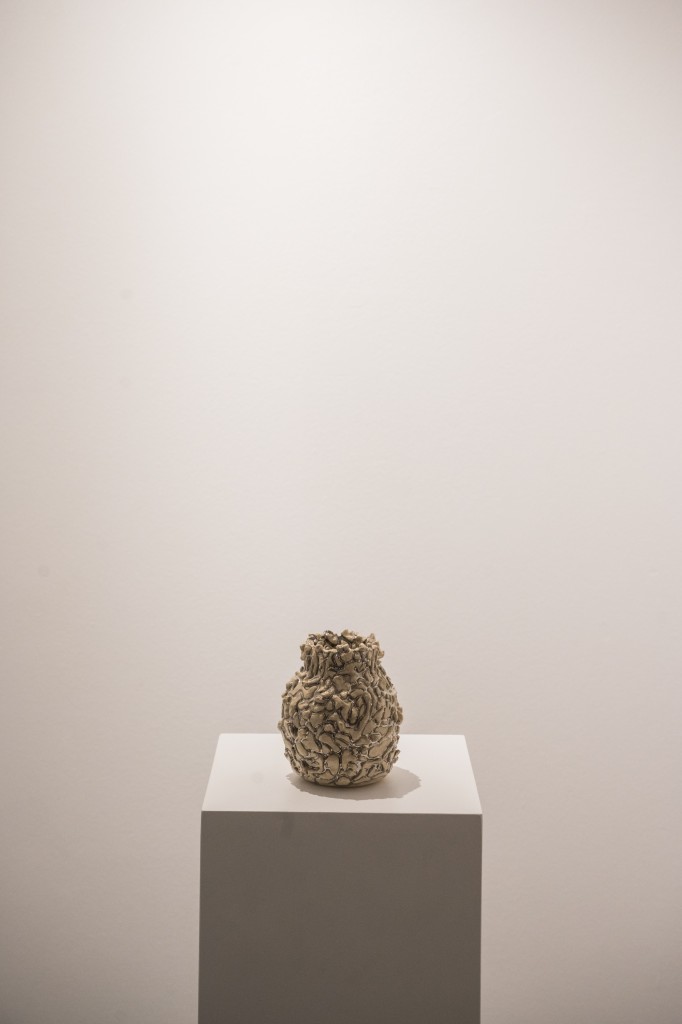
Anna Karountzou who is also inspired by her hometown, Oia in Santorini, presents the collection “Stomata” meaning “mouths”, which are forms and figures that have movement and rhythm. Stomata consist of shapes and figures of motion and rhythm. All together in total, and at the same time each one in a different tone, constitute a polyphonic ensemble, embracing one another and composing a song. Each piece is an autonomous chapter. A single note, a single sound. Her personal symphony. The artist chooses to work with earth-tone stoneware clay mixed with volcanic sand-gravel that she collected from Santorini. Pieces with memories from her summers.
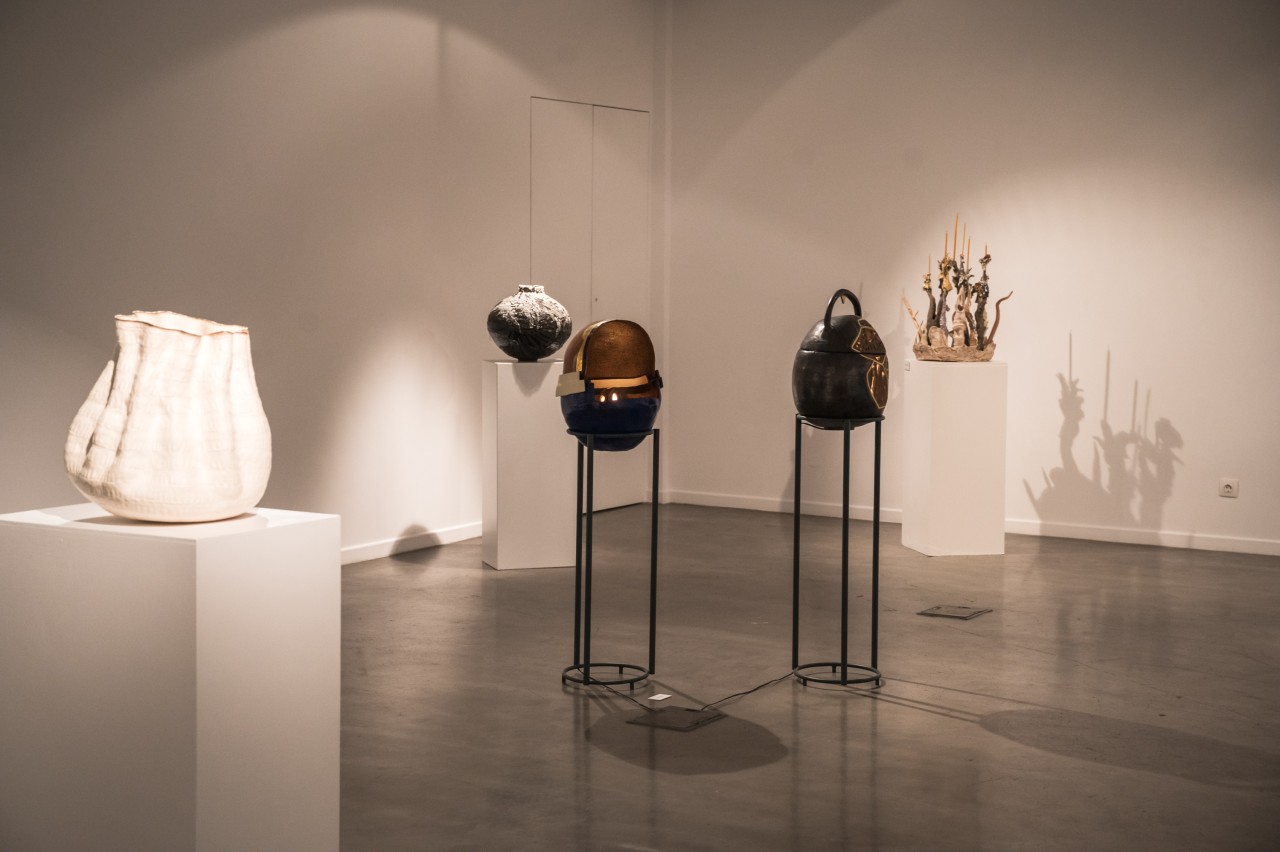
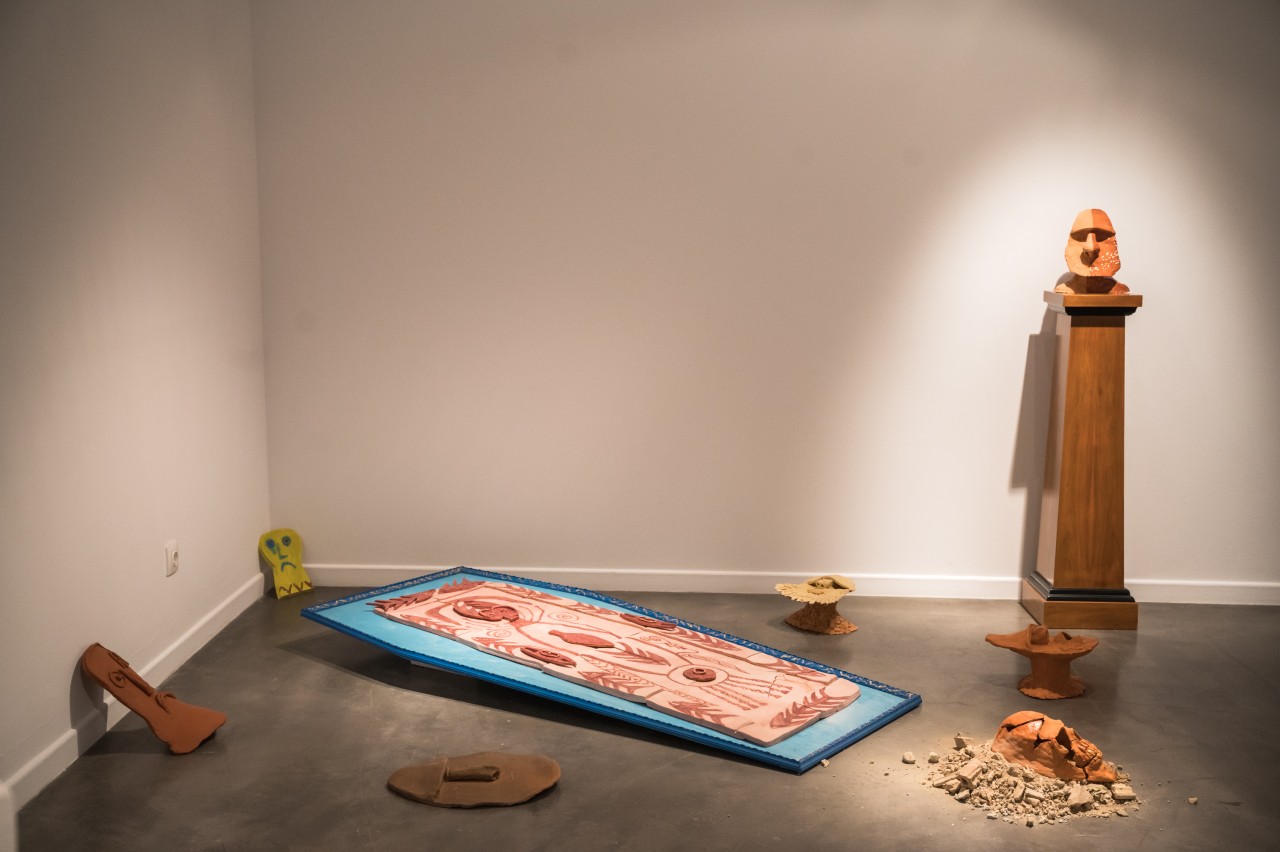
Panagiotis Lezes with his ceramic anthropomorphic masks shouts in despair for something unknown to come. One of the most representative motifs, the skull, that also appears in the painting, crushed as an excavation find, converses with figures and masks, simulations of grave offerings that may replace or even be Fayum. All the masks are placed on the floor, the closest level to the soil, looking up at the sky and imploring the viewer to come to their senses while there is still time.
Natalia Manta presents the works VESSEL 1 & 2 which are part of a wider unit entitled Imaginary Landscapes in which she deals with the investigation of the mythological element. In this series she collects and uses symbols of world history and tradition thus creating an underground dialogue between the local and the universal element. Thus, the sculptures seem to emerge from imaginary worlds/places, where time can flow unorthodoxly with the present entangled with the past and imagination with reality.
Irini Theodosi (irzzy) draws inspiration for the artwork named “QUERNOS” (an ancient Greek vessel used in the Eleusinian Mysteries for the ritual sacrifice of food.) from the ancient Greek kernos, seen in a contemporary self-referential context. It remains, today, a ceramic cluster of vessels and cavities ready to receive offerings. The work is an abstract reference, as in a dream with symbolic unconscious shapes that represent concepts, memories, feelings and states. The encounter with Theodosis’ artwork creates the sense of the body and of the transcendent, of the sacred, the religious ritual, and ultimately the metastasis of the existential "I am” state.
Maria Economides, inspired by the anatomical votive offerings, employs the ancient technique that involves creating forms without a pottery wheel, using the hands, fingers and simple tools. Decorated in bold colors with slips, terra sigillata or glazes the forms aim to create a play between the functional and the sculptural, always with a dose of humor.
Philippos Theodorides,a painter and illustrator , started to experiment on a three-dimensional surface. Shapes and forms in various colors began to appear, which he then incorporated into his paintings. The designs and patterns that emerge in his practice are more or less random and reminiscent of fragments of ceramic vessels from antiquity. Many times he chooses to draw an eye which has direct references to popular culture and superstition, a sun or simply writes the letter Ω - omega, which he likes as a shape. His ceramics are utilitarian, usually vases or plates.
Maru Meleniou explores abstract concepts such as that of "contain" and "rhythmic palpitations'' through her work titled Vessel No 11. It’s organic form transcends the rigidness of the medium and seems to be vibrating with vital energy. Meleniou's vessel is not trying to be a perfect white, rather it carries a layering, in an attempt to search for a way to feel whiteness. Shape and color are attached to concepts such as emptiness, possibility, exploration, concepts that the artist is very interested in as she believes the purpose of a vessel is to contain emptiness, a goal large that its function.
Similarly, Janet Lines investigates the unknown, and the emotions this precarious state brings into being. Her sculptures explore the external and internal, both physically and metaphorically. Openings, the junction between space occupied and contained, are reminiscent of mouths, entrances to narrow passageways or cavernous interiors. Using metaphors of sticks, bundles and sacks, familiar objects in abstract form, these pieces articulate the fragile and vulnerable state of displacement and dis-belonging; of being confronted by the Unknown.
For Alexandra Manousakis ceramics inspire a sense of comfort / familiarity with the earth. They make us feel grounded or rooted, and they intensify the feeling that moments are fleeting. Τhe artist states that there aren't many materials that offer this type of dualism; calming and anxiety-inducing, all at once. One wrong move and the original form can be lost forever, shattered or cracked. Drawing and painting on large vessels offers the illusion that we can somehow control these objects and their fate. The irony in this is that the more effort we put into these pieces, the more difficult it is to fathom that something can happen to them. The fragility of ceramics works like a veil that covers and guides the relationship someone has with them as the creator, but also as a viewer.
Melina Xenaki draws inspiration from the Greek ceramic heritage and creates contemporary works with techniques that reflect and celebrate the raw and direct style of the characteristic ancient Mediterranean ceramic objects bearing designs, animals and plants.
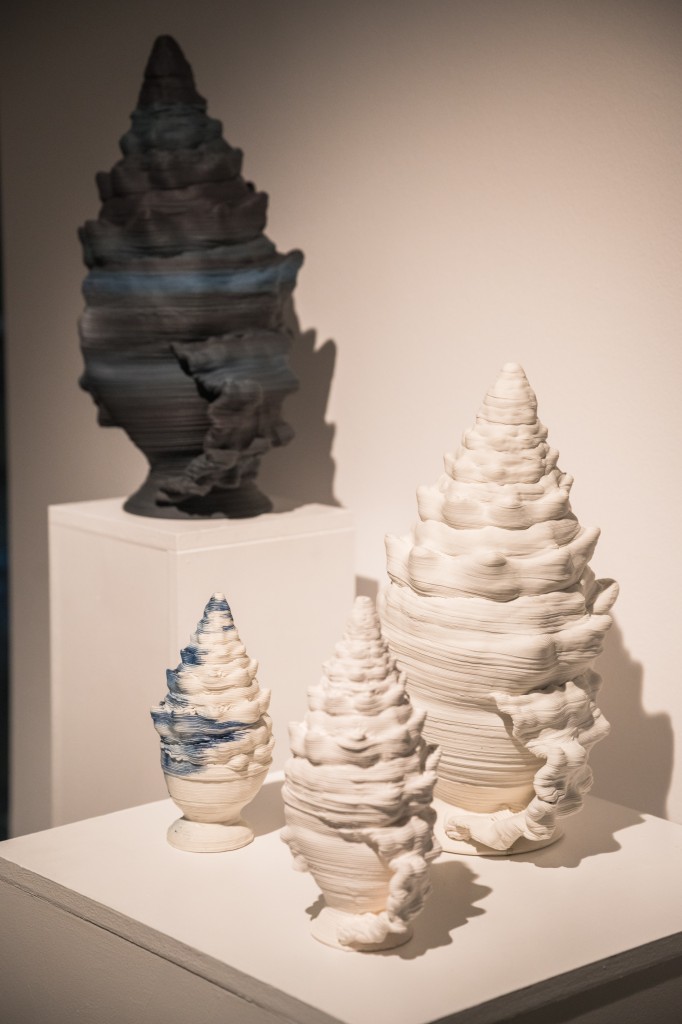
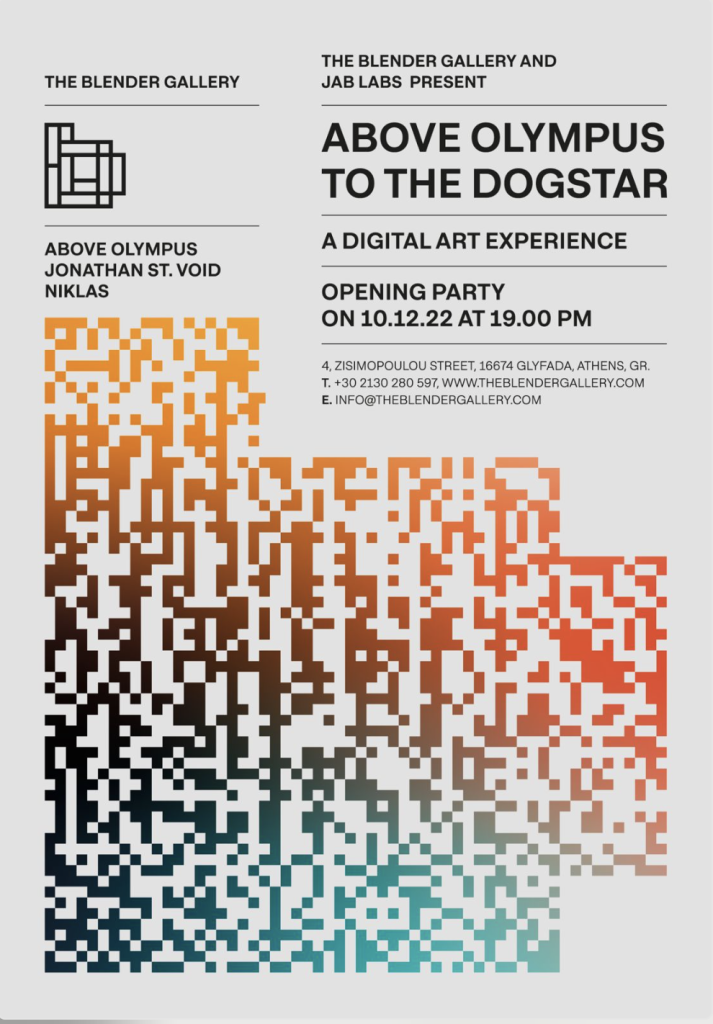
Last but not least, the designer Nikolas Athanasopoulos (Niklas) who significantly differs in terms of his technique from the rest of the participants of this exhibition as he chooses a modern way of creation, the initial applications of which were realized in this century for practices such as artificial body parts, design, etc. The designer puts emphasis on new technologies and in particular on 3D design and printing of ceramic objects (3D ceramics printing), as he sculpts immaterial shapes which he implements in the physical space with 3D print ceramic technology. For the exhibition Shapes of Stories, he created an art piece inspired by the trend of the 18th century when the artists decorated the belly of the vases, vessels, urns with naturalistic elements which they either pasted or painted on the ceramic. Taking this naturalistic approach and the basic geometry of 18th century ceramics as a starting point, a shell of the genus Coralliophila was digitally scanned and then processed in such a way as to create the present artifact.
The practice of the selected artists demonstrates that the revival of ceramic art in the world of fine arts is releasing the medium of clay from its traditional functional imperative, redefining the ancient art form in new ways. Clay has become a medium of sculptural expression, with remarkable breadth and approaches, telling stories and depicting popular culture. It is a form that blends art design and also functions with traditional, modern and experimental techniques.


.jpg)