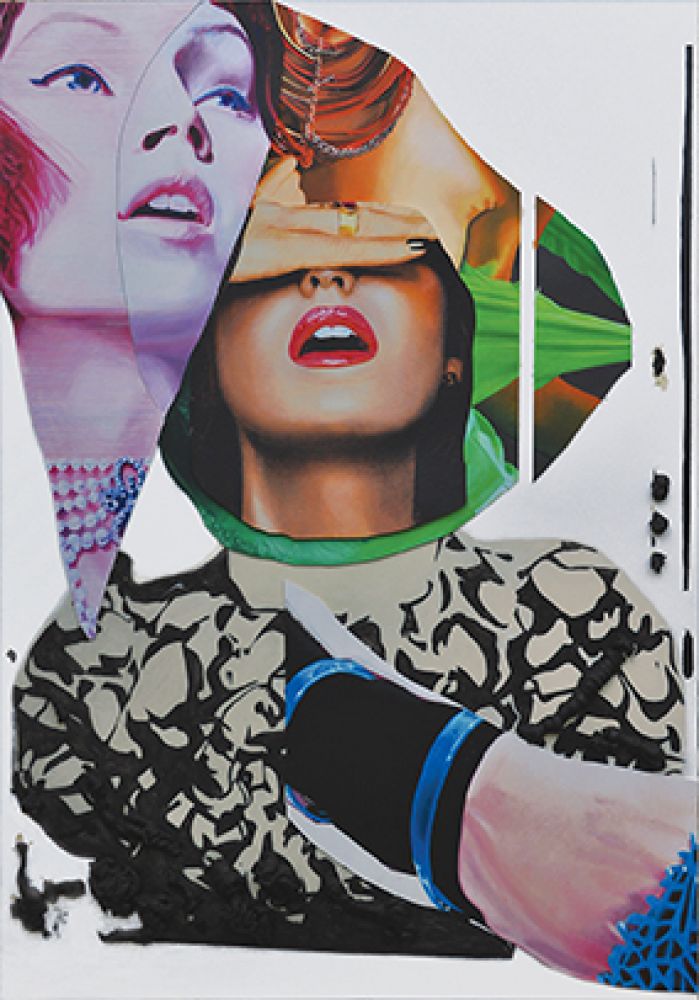

Τhe term "Upskirt" is the child of the urban dialect and refers to photo shots of beneath the female skirt, revealing the underwear and the "area" around it. Also, the word is used, in its wider sense, to describe photographic images capturing private moments. Those images intrigue the imagination of the viewers, especially when they concern a famous woman from the showbiz world, as she is in the center of attention and desire. In reality, those small "accidents" embed the elements of the unethical and of the forbidden. Unethical is he who reveals such a personal detail from one's body or life by publicizing the image, and what if forbidden is the viewing of that image. No one can forbid, however, the mind's games, dirty thoughts and erotic phantasies. The exhibition titled "Upskirt" presents artworks dominated by women. The female face: the eyes and the look, the lips and the enigmatic smile. The female body: the delicate silhouette, the body's stance, the dresscode, the touch of objects. The non-linguistic communication is found everywhere, innuendos and subcutaneous messages are hidden in details. Kostas Spanakis extols the pure and clean eroticism of the female figure and yet at the same time highlights the dangerous, mysterious side of it. In his works one meets deadly women (femme fatale) - women holding guns, not hesitating to target their lover and to possibly pull the trigger. On other occasions the female character is depicted as the "next-door girl". She wanders unwittingly half naked, she enjoys her the wine, she day-dreams, she seduces with disarming smiles. In most of Spanakis' work, the faces are absent, while emphasis is given on the most hidden and erotic spots of the female body. The perspective adopted by the artist creates a "keyhole" context, which constitutes the role of the viewer to more than that of just a casual observer: The viewer, like a naughty child, peeps through the keyhole and enjoys the sight of the female body which appears so available and seductive, and he is called to envision what is not within his sight. On other occasions he spies like an audacious photographer, who, through the camera lens he zooms in his point of interest. In this way, it is suggested that the women are not aware of the fact that they are being "followed", and as a result an air of innocence is added to their nakedness, a nakedness that is, which can only cause the viewer's admiration. The use of typography, the graphic design aesthetic, the intense contrasts and alternations between vivid colors and blank space are some features of Konstantinos Bedrdeklis artistic style. His unique technique, in combination with the stylized female figures appearing in his work, awaken associations with magazine covers and opens the door to worlds with which the viewer is very familiar – that is to the world of fashion and advertising respectively. Women, in his work, appear sexy and powerful beings of unrivaled beauty. The artist does not let the impeccable and re-touched (fashion re-touche) women to suffocate within the canvas' limits. The protagonists of magazine covers obtain a three-dimensional substance in the works of the artist, and touch the viewer, the enchanted consumerist audience that passively idolizes them. The elusive beauty models become more "real", and stalk the contemporary woman throughout her everyday life, by intruding in their subconscious as idols of beauty and sexappeal. The transition from the drawn depiction to the three-dimensional representation of the untouchable models, highlights the ironic stance of the artist concerning the commodification of women. It is hard to understand the time context in which the characters are placed as the works of Berdeklis are a mixture of retro, contemporary and futuristic elements. Perhaps the reason for that is the desire to emphasize the development and the enforcement of beauty stereotypes throughout all times – past, present and future. Τhe woman, in Erimou's work, looks often decisive and emancipated, and often fragile and absorbed by the hands or the kiss of masculine figure. Inspired by how the industries of fashion and advertising shape the female stereotypes, the painter, sheds light upon the ideal suggesting that behind the appearances there are internal values, the source of true beauty. The fluidity of the wide strokes of oil on canvas, as well as the absence of outlines are characteristics of her technique which are associated with the theme of ephemeral personal relationships. Aggeliki Erimou places her characters within the familiar domestic environment, whereas on other occassions she does not limit herself, and with the help of the perspective within the piece itself, the inside and the outside interchange. The expressions and the body language hide emotions which are innocent, indifferent, focused, twisted and thoughtful. The bodies, left in love or comfortably seated in repeated motifs, depict scenes which seem eternally frozen in time or alternatively, are characterised by an indefinite movemenat as if everything is about to come to life and change. Looking at her work as a whole, the woman looks like she is experiencing a constant conflict between the deep desire to experience the forgotten romanticism of other times, and her survival instinct against the contemporary, cruel and superficial reality of human relationships. Konstantinos Berdeklis presents through his original technique the magazine covers woman, and he criticizes the fashion stereotypes, by challenging the viewer to see the bigger picture. In Kostas Spanakis' work the "by-mistake" provocative, the beautifully elusive and the innocent and at the same time dangerous female nature is depicted, while in Erimou's work the idolized personas indicate the various roles of the woman from a romantic, almost cinematographic perspective. The female figures express in their essence, the mentality and the personality behind the image. Lifting teh skirt (upskirt) of the apparent and the beautiful and looking behind the drawn surface, one sees the current times and teh dominant stereotypes of it, the time and space, the human relations and teh roles of those characters, the possible feelings they are possessed by and their intentions.
Leonie Gavrias, Efi Palli